

Temp: 26°c
Today, we set off towards the Florida Gulf Coast University, to learn about the process of ringing birds (banding in the USA) and go slogging in the Cypress forest.
On arrival, we were treated to the sight of a woodpecker clinging to a dead tree. We took photographs of it pecking for food, while waiting for the bird ringing activity to start.
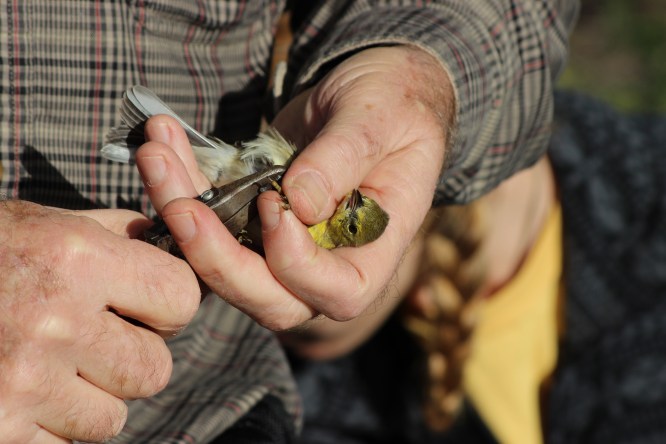
A short while later, we were met by the guy in charge of the bird ringing; he led us to a wooded area not far from the University car park. Within this wooded area, a mist net had been set up. This netting is completely humane and designed to catch the birds with the least amount of stress and harm possible. The nets had already caught a few birds, these were Pine Warblers a lovely green and yellow colour.
To keep the birds from being hurt, they were placed into socks which being dark kept them calm. They were then carried out to a table that had been set up in the car park with all the bird ringing resources. Once, we were all gathered around the table the bird ringer proceeded to tell us the history of bird ringing.
He then proceeded to note down the age, the weight and the gender of the bird in a note-book next to the rings serial number. If a single ring is lost it needs to be deleted from the list. The bird was then released and we returned to the woods to look for larger birds. Several Gray Catbirds had been caught and were now ready to be ringed. At that same moment, a member of staff said that a Painted Bunting had been sighted, so Sam Whittaker and I asked if we could search the woodland for it on our own whilst the Gray Catbirds were being ringed. We were granted permission and set off in search for the Bunting. Unfortunately, we were unable to find it although we were treated to the playful behaviour of a Northern Cardinal.
After the demonstration of ringing we gathered by a small pond to wait for a man called Wynn. He was a true individual, cool and totally happy with life. He took us to the two wetland habitats we were allowed to explore. The first was only ankle deep and consisted of grasses, the other was much deeper. These wetland areas are as a result of a construction company digging drainage trenches, these areas are unique as construction company’s usually only dig long shallow drainage trenches.
We didn’t spend long in the shallow area as there wasn’t a lot of wildlife to see. On the way to the deeper site Sam found a partial snake skin which was apparently from a Racer.
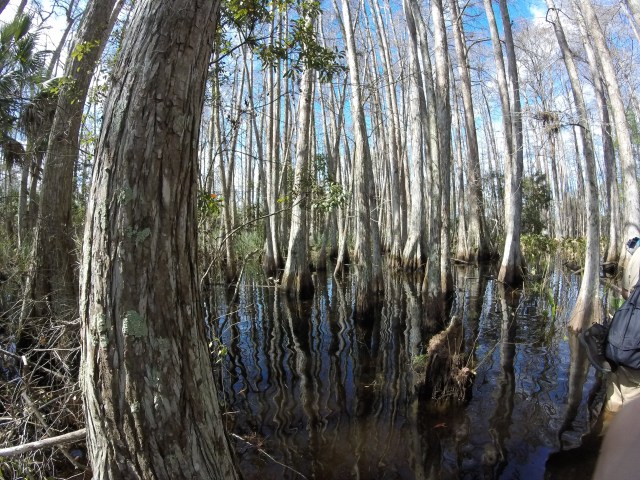
On arriving at the deeper area, we observed a huge contrast between the two wetland areas. This wetland had huge Cypress trees and an area consisting of grasses dividing them from Pine trees closer to the road, this area is called a firebreak. The pines that are resistant to fire grow on the one side and the Cypress trees grow on the water rich side.

I ventured into the Cypress forest with Sam and Laura. We headed for the deepest part as it was known to be a better place to find the more interesting organisms. Indeed it was, within minutes we found various species of water spiders and other insects. It is a shame that they are so hard to photograph without a macro lens and I ended up trying with my GoPro but to no avail.
Sam wandered off, almost falling over after stepping into a small sinkhole submerged under the water but luckily steadied himself before he drenched his camera. Laura and I were busy looking at each insect we found, Sam on the other hand was determined to find frogs and snakes. Little did he know we had already come across two frogs along with many Cuban Anole lizards after he had slogged off.
A short time later, someone exclaimed “SNAKE!” A few of us slogged our way through the water with Laura half drenching herself on the way. Indeed there was a snake, it was an Eastern Ribbon Snake, working its way towards where I was standing, slithering over the fallen trees and wetland vegetation. Sam had arrived at this point and we decided to catch it. I attempted first and it hissed at me so I backed off. When it was most exposed, Sam leant forward and caught it, unfortunately for him it began to musk making him stink. We proceeded to pass it around the group that had gathered. It behaved extremely well for a wild snake and after a short while we placed it back on the fallen tree and left it be.

On leaving the Cypress forest we travelled down the same road on the opposite side and Wynn proceeded to open up the manholes in search of more snakes. Instead, he found hatched eggs which he assumed to be from Racers. For a little fun, he suggested we washed ourselves off in the University fountain before eating lunch in the cafeteria.
After eating ourselves silly we headed to another part of campus to listen to a talk on the Florida Panther.
The Florida panther ( puma concolor coryi ) firstly is not black its a common misconception that all big cats with black pigment are panthers whereas the only panther, is the Variant of cougar from Florida. There are approximately 120-180 panthers left in the wild . They are critically endangered , a panther males territory is 200 square miles overlapping with females the female only has only about 80 square miles. The Florida Panther breeds all year round although gestation take 3 months. the common threats to Panthers are:
- Habitat loss
- Territorial needs:males will kill each other.
- car collisions
- disease
 Zoological Adventures featuring Tom Everley