
Temp: 29°c
Today we headed once more to the Florida Gulf Coast University, our first stop of the day was a short talk on wetlands by Bill Mitsch, who literally wrote The Book on wetlands! From his talk I found that one of the main preconceptions on the most effective way of reducing greenhouse gases is incorrect. This being the fact that rainforests are the best, in fact they have no effect in the reduction, the existing trees in rainforests give out as much gas as they absorb. Newly planted trees would be effective for a duration but not half as much as the key extractors of greenhouse gases: wetlands more precisely mangrove trees. Unlike most plants that give out methane as well as carbon dioxide, mangroves give out methane and Sulphur, and when these two combine they break down to form non greenhouse gases.
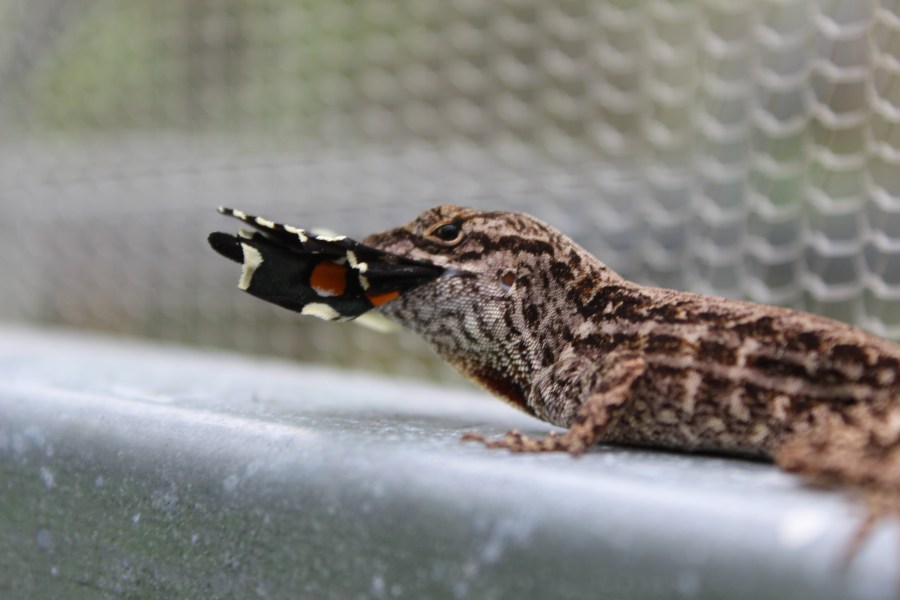
After the talk from Bill Mitsh, we drove to the Naples Botanical Garden where we were told we could explore until a designated time, several people went round recording all the species native and not for their species list. I myself took a more leisurely approach and wondered round just observing what I could see. Finding myself in the butterfly house I found that all the species within were native so I attempted to photograph these for my own list. On leaving the butterfly house I noticed a Cuban Anole on a metal support on closer inspection I saw it was in the process of eating a butterfly I took a photo of this behaviour.
A short walk from the butterfly house is a lake that apparently contained Alligators, after close scrutiny I couldn’t find any. Along the edge of the lake was a large telegraph pole with an Osprey nest on top. Looking around the base, I was lucky to find a small feather, this was a great find as I love birds of prey and this feather would make an excellent addition to my already bulging hat.
On route back toward the centre of the park I bumped into Emma and (thingy), they said they had seen some Green Anoles and showed me a picture I immediately asked the directions and attempted to find them, unfortunately I had no luck only seeing copious amounts of the Brown Cuban ones.
A short while later, we gathered near the entrance where we found out we would be having a BBQ with some university students before the big invasive species talk that night, we would be stopping at Walmart for supplies. On arrival at Walmart I took the opportunity to restock on food and buy myself some steak for a treat being tired of junk food.
We arrived back at the university and gathered in the car park and just as we began to panic that nobody would turn up a pick up truck arrived carrying the BBQ and out of the wood work students began to arrive. It was interesting socialising and hearing with the American students about what they studied and did in their spare time.
Not long after grabbing some food we headed into the lecture room for our talk. The Invasive Species Epidemic, sounded extreme but after listening we began to see the full scale impact, how easy it is for species to transfer and this isn’t just things like animals and plants its microbes, these can get from place to place with ease. The talk proceeded to explain the methods of managing and preventing invasive species taking hold. For example tighter control on borders, fumigating of water and air vessels, such as cleaning the ballast tanks which are a major method that invasive species are often transferred.
As a whole the main method for managing the epidemic would be to ensure worldwide cooperation when it comes to trade and commercial travel between areas ensuring no harmful species are transferred out of their native ranges.
 Zoological Adventures featuring Tom Everley