Adventures Around The World Will Never Be The Same.
Author: Tom Everley
Oh there's an about page. Well I guess you can have some bullet points of information:
* Music:Mostly rock
*Photography is one of my favourite hobbies and past times.
*I am a Zoologist.
*hopeless romantic
*PC gamer.
*animal lover.
*not the best with grammar so have fun reading.
Today we drove down Alligator Alley and there was a inter van competition to see who could count the most. Our total was around 60 alligators.
Halfway through the journey into Panther territory, illness overcame me. I have no idea what caused it. I have a hunch it was a breakfast burrito (shame as it tasted great), but could have been a bug. I then proceeded to throw up every half an hour and feel totally fine in-between this was very annoying. On the upside I didn’t miss any panthers. Not a single one was seen on the road supposedly where the most sightings occur.
While suffering I managed to still go on the treat of the day a trip round the Everglades on an airboat. Not the wisest thing to do but I was determined to do this once in a lifetime opportunity and oh it was worth it! We set off slow and I was panicking about throwing up but as soon as we left the channel the driver put his metaphorical foot down and launched the boat forward at high speed. We went from a narrow river channel to a large wetland grass environment in minutes where we saw various birds. We proceeded to do several drift like turns, like those you would expect in a movie.
We moved to one of the manmade canals that is deeper than the main areas of the Everglades. This was an area where the guide knew where the alligators would be that he had given names. I think one was called something like Derek but I can’t be sure. After a fair amount of whistling he got Derek to show his face the guide proceeded to give a brief talk about him, I was more focused on not throwing up in gator infested water! Leaving Derek and his gator gang behind we returned back to the dock, where the rest of the students went for a brief talk from one of the guide people (very touristy), they also got to hold a baby gator. Unfortunately, when everyone else was having a great time holding a baby alligator (very jealous) I was incredibly sick the boat trip had taken the last of my energy I can’t remember too much after that besides sleeping on the long journey back broken up by a brief vomit.
On arrival back at the Vesta Field Station, Christian suggested as we were early that we go canoeing, having just purged my stomach for the last time I felt it would be worth the risk and it was! We saw various mangrove dwelling organisms including a Pileated Woodpecker.
The second video is of us observing a mangrove crab.
I didn’t even make the nights debrief I was so exhausted.
(Hope you enjoyed the details of the 24 hour plague, I was not the first or the last to suffer.)
Today, we set off towards the Florida Gulf Coast University, to learn about the process of ringing birds (banding in the USA) and go slogging in the Cypress forest.
On arrival, we were treated to the sight of a woodpecker clinging to a dead tree. We took photographs of it pecking for food, while waiting for the bird ringing activity to start.
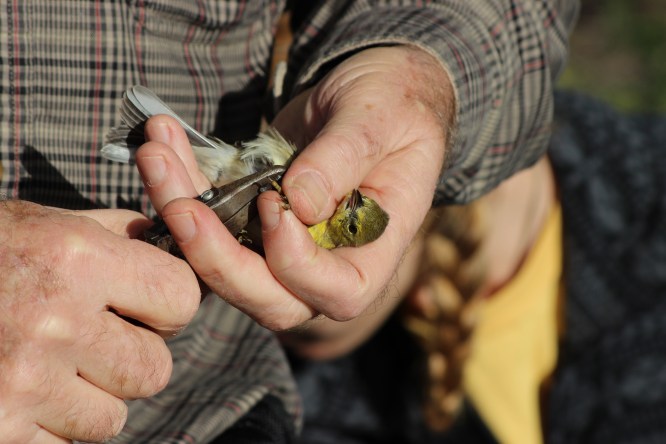
A short while later, we were met by the guy in charge of the bird ringing; he led us to a wooded area not far from the University car park. Within this wooded area, a mist net had been set up. This netting is completely humane and designed to catch the birds with the least amount of stress and harm possible. The nets had already caught a few birds, these were Pine Warblers a lovely green and yellow colour.
To keep the birds from being hurt, they were placed into socks which being dark kept them calm. They were then carried out to a table that had been set up in the car park with all the bird ringing resources. Once, we were all gathered around the table the bird ringer proceeded to tell us the history of bird ringing.
He then proceeded to note down the age, the weight and the gender of the bird in a note-book next to the rings serial number. If a single ring is lost it needs to be deleted from the list. The bird was then released and we returned to the woods to look for larger birds. Several Gray Catbirds had been caught and were now ready to be ringed. At that same moment, a member of staff said that a Painted Bunting had been sighted, so Sam Whittaker and I asked if we could search the woodland for it on our own whilst the Gray Catbirds were being ringed. We were granted permission and set off in search for the Bunting. Unfortunately, we were unable to find it although we were treated to the playful behaviour of a Northern Cardinal.
After the demonstration of ringing we gathered by a small pond to wait for a man called Wynn. He was a true individual, cool and totally happy with life. He took us to the two wetland habitats we were allowed to explore. The first was only ankle deep and consisted of grasses, the other was much deeper. These wetland areas are as a result of a construction company digging drainage trenches, these areas are unique as construction company’s usually only dig long shallow drainage trenches.
We didn’t spend long in the shallow area as there wasn’t a lot of wildlife to see. On the way to the deeper site Sam found a partial snake skin which was apparently from a Racer.
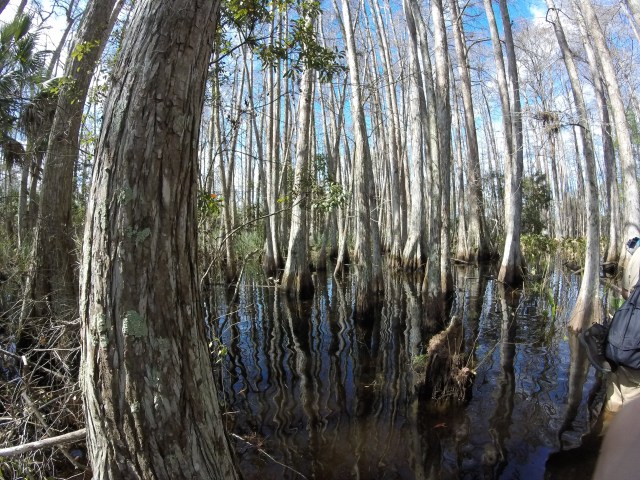
On arriving at the deeper area, we observed a huge contrast between the two wetland areas. This wetland had huge Cypress trees and an area consisting of grasses dividing them from Pine trees closer to the road, this area is called a firebreak. The pines that are resistant to fire grow on the one side and the Cypress trees grow on the water rich side.
Firebreak Cypress swamp area at the rear of photo.
I ventured into the Cypress forest with Sam and Laura. We headed for the deepest part as it was known to be a better place to find the more interesting organisms. Indeed it was, within minutes we found various species of water spiders and other insects. It is a shame that they are so hard to photograph without a macro lens and I ended up trying with my GoPro but to no avail.
Sam wandered off, almost falling over after stepping into a small sinkhole submerged under the water but luckily steadied himself before he drenched his camera. Laura and I were busy looking at each insect we found, Sam on the other hand was determined to find frogs and snakes. Little did he know we had already come across two frogs along with many Cuban Anole lizards after he had slogged off.
Wetland (Deep)
A short time later, someone exclaimed “SNAKE!” A few of us slogged our way through the water with Laura half drenching herself on the way. Indeed there was a snake, it was an Eastern Ribbon Snake, working its way towards where I was standing, slithering over the fallen trees and wetland vegetation. Sam had arrived at this point and we decided to catch it. I attempted first and it hissed at me so I backed off. When it was most exposed, Sam leant forward and caught it, unfortunately for him it began to musk making him stink. We proceeded to pass it around the group that had gathered. It behaved extremely well for a wild snake and after a short while we placed it back on the fallen tree and left it be.
On leaving the Cypress forest we travelled down the same road on the opposite side and Wynn proceeded to open up the manholes in search of more snakes. Instead, he found hatched eggs which he assumed to be from Racers. For a little fun, he suggested we washed ourselves off in the University fountain before eating lunch in the cafeteria.
After eating ourselves silly we headed to another part of campus to listen to a talk on the Florida Panther.
The Florida panther ( puma concolor coryi ) firstly is not black its a common misconception that all big cats with black pigment are panthers whereas the only panther, is the Variant of cougar from Florida. There are approximately 120-180 panthers left in the wild . They are critically endangered , a panther males territory is 200 square miles overlapping with females the female only has only about 80 square miles. The Florida Panther breeds all year round although gestation take 3 months. the common threats to Panthers are:
Today we journeyed to the Loxahatchee reserve where an experiment is in constant effect, this is LILA: Loxahatchee Impoundment Landscape Assessment.
LILA is a system of four identical scaled down pools that emulate the Everglades ecosystem, these pools can have their water levels altered to any required level.
The natural hydrology of Florida is unknown as no records exist before human colonisation.
The hydrology of the Everglades is always uncertain.
The role of LILA is to attempt to correct the hydrologic condition of the Everglades. LILA can independently manage the water level and timing of higher or lower water levels to test the restoration of the area. The key parts this manages is the quantity of water, the time that water is in drought or flood and the sections of the bodies of water these occur.
Before the destruction of the Everglades the area was home to approximately 100’s of thousands of nests this number has dropped to at least 20-30 thousand.
A tree is a biodiversity hotspot. The Everglades has lost 90% of its tree islands since the effect of man altering the flow of water.
The LILA reserve has a record of 7000 trees they can find out the life data for. Half of these have been killed as a result of the tests although this is good as it can show the effects of changing water conditions.
Additional observations: on route to the Loxahatchee Sam Whittaker and I went exploring and stumbled along a deceased White Pelican its head had been picked clean of skin and flesh whereas its body was still covered in white feathers our initial theory that it was attacked by an American Alligator shortly after catching its lunch; there was a fish found less than a metre away.
The absence of the body being eaten might suggest otherwise unless the alligator just fancied a nice flabby bill snack.
My other theory is that the White Pelican just died of an unknown cause and since then the corpse has been scavenged by raptors such as Black and Turkey Vultures, there was an American Kestrel perched nearby although the size of the kestrel makes scavenging the pelican unlikely.
Animals:
We saw various species of animals on the Loxahatchee reserve many of which were birds highlights were the baby Screech Owls in the nests above the swamp the super-fast Black Racer, a huge terrapin or (turtle) as they say over here, a Purple Gallinule and a tiny green tree frog I’ve yet to identify. We also observed several Bald Eagles which are astoundingly more common than expected.
Waking up at 6am this morning ‘fun’! After getting dressed, I went to explore and re found the wasp nest site, the wasps were paper wasps which was really cool to see.
The moon was still up at half past seven, crystal clear with the craters visible to the naked eye.
Just before setting off we saw a Mourning Dove on the power lines it looked fairly similar to the native collard doves found in the UK.
At 8am we set off towards Merritt Island Federal Reserve which is right next to the NASA launch site. The journey took approximately an hour we saw various bird species and several dead animals on the side of the road including a Raccoon and possibly a Porcupine which is unusual to see.
The birds we saw were Great Egrets, White Ibis, Wild Turkeys and Pelicans. Loads more species were seen over the whole journey from a to b. Close to the arrival to the reserve we saw a large group of Ospreys fly over the road flying low then moving higher into the thermals above the water.
After arriving at the reserve we were given a talk by the rangers, we were informed that NASA bought the whole area back in the 60’s. After a few years they realised the whole area was too big and didn’t require as much space so handed over management to the US Fish and Wildlife Service. The main role of the Service is to maintain the welfare of the migratory bird and the native waterfowl species. There are 93 endangered species present in the reserve this includes the Florida Scrub Jay and several sea turtles.
The methods of managing the area is by regulating the water levels using dikes. This aids the water fowl by retaining the optimum conditions for them to thrive. Florida is the lightning capital of the world this benefits the vegetation levels with natural fires occurring. Due to human intervention this had been altered and managed fires are produced on the reserve to emulate this. The main invasive species effecting the reserve and is almost impossible to eradicate is the Brazilian Key Pepper which does not benefit any form of wildlife.
The down side to the reserve is that at any point NASA can reclaim any of the land they desire ‘Space Comes First’. NASA chose to purchase the area for its proximity to the ocean and large flat area this allows any space debris to fall in unpopulated areas.
The space launches generally effect the birds, as they can often build their nests on the launch pads or vultures perch on the shuttle. Although there has been an instance when a bat has ended up being launched into space!
After the talk we were accompanied by guides around the rest of the reserve going to various sites that were ideal for finding specific species, these included Scrub Jays, Rattle Snakes, Manatees and Bald Eagles, all of which we saw.
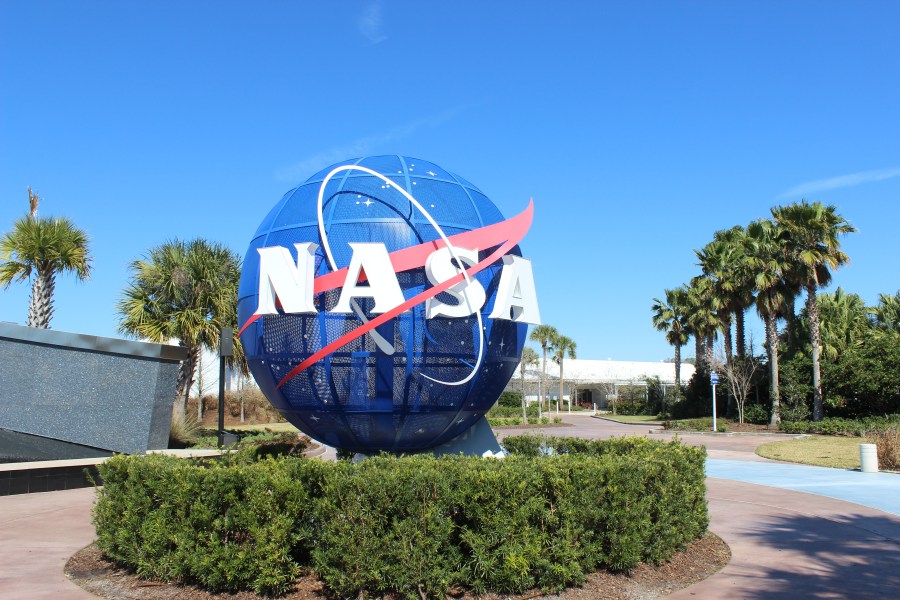
Part of today’s trip was going around Kennedy Space Center itself, this was phenomenal learning about the space exploration. The funny part was that we spent more time looking at the wildlife than the Space exhibits.
Here are a few of the interesting space sights and a video of Falcon 9 that launched a few days later.
We landed after a 9 hour flight which wasn’t too bad. Plenty to see out the window going down the east coast.
After arriving at the hotel, exploration ensued several geckos were identified this could possibly be the Mediterranean invasive species or the native house gecko of Florida. More research and observations will be required.
Also, several wasp nests were spotted on the roof of the hotel.
In two days from now myself and several other students from the university of Bangor will be heading overseas to the United States to go to the Florida to study the Wetland environments what lives there and why.
While we are there we will participate in various activities several of which will involve getting wet.








 Zoological Adventures featuring Tom Everley