All content is written on mobile so grammar and spelling may be off.
Early start this morning up at 6, breakfast at 6:45 which consisted of smoked meats and an optional cooked eggs and bacon. I opted for both. After that is was a quick turn around before heading to the van to our long road trip to Fish canyon (canyon village). On route we stopped at one of the few Quiver tree forests. These are named as the bushman use the bark if the tree to make their quivers for their arrows.
These trees were amazing and looked so cool between the large black rocks in which they grow.
Shortly after we ventured back to the van to finish our final leg of our journey to Fish Canyon only stopping briefly to observe the old German railroad.
On arrived at Canyon village we were greeted and informed there would be an evening sunset walk if we wanted to go. My family decided that would be a splendid idea.
In the time between sunset and arrival my family decided to spend it by the pool. Not being a fan of lougeing around I decided to explore the surrounding rocks after reaching the summit several birds flew past me so I bounded after them unfortunately I didn’t manage to photograph them. On the up side I did get to see some hyrax which look like little vampire guinea pigs.
A while into watching the hyrax on my rock my dad hobbled up to fetch me to get ready to the sunset walk. So we got ready for the walk and we’re introduced to our guides who immediately showed us the Quiver tree again. Another few meters into our walk we stopped by a large bushy plant called Aphombia Grengaria this plant is extremely poisoness to humans so shouldn’t not be inhaled it ingested. Although certain animals such as Kudas eat them to kill intestinal parasites. We came to a large hill and we’re informed we would be climbing it and so we set off and scaled it. On top the view was phenomenal we stood there drink in hand as the sun set and the stars appeared.
Awoken from my sleep quite early this morning by my mother I proceeded to get dressed, not having time to shower due to my brother taking ages.
Breakfast was anything you could think of plus bacon which was surprisingly nice.
After a short session of repacking we checked out and waited in the garden for our driver. I spent this time camera pointed into the trees desperately trying to photograph the birds flying to and fro.
The driver arrived and greeted us with a smile. His name was Leonard, informing us we would have him for the duration of our trip. Packing up the car we set off I took the chance to sit up front so not to miss a thing.
On route Leonard informed us that presently the people of Namibia are divided into 14 tribes.(Will add later) the largest of which governs Namibia.there are four main industries in Namibia which are construction ,tourism , export and mineral extraction.
Our main event of the day was a trip into the Kalahari.
On arrival at the private Kalahari game reserve. We were offered a safari trip, without hesitation we accepted.
the time between the safari arriving was spent near the pool myself wondering off taking photos of ground squirrels various birds ,antelope(broad term) and lizards.
Evening came around shortly and we gathered around for a quick drink before getting into the jeep. We set off and within minutes we saw animals left and right. Springbok, Kudu, Oryx, Ostrich, Black faced impala, Blue wildabeast.
These were nothing compared tp the treat we got of a close view f the reserves female lioness. she was just waking up as we found her yawning loads showning off her huge teeth. The best of the best was the sun set right at the end. We drove up atop of one of the many red sand dunes and watched the sun go down , drink in hand it was breath taking you could go anywhere in europe and not get a view like that.
by the time we left the sand dunes it was dark and the sky was iluminted with stars and planets. breathtaking to say the least.
After a long flight, my family and I arrived in Johannesburg, South Africa. We had a short wait before boarding our hour long flight to Namibia.
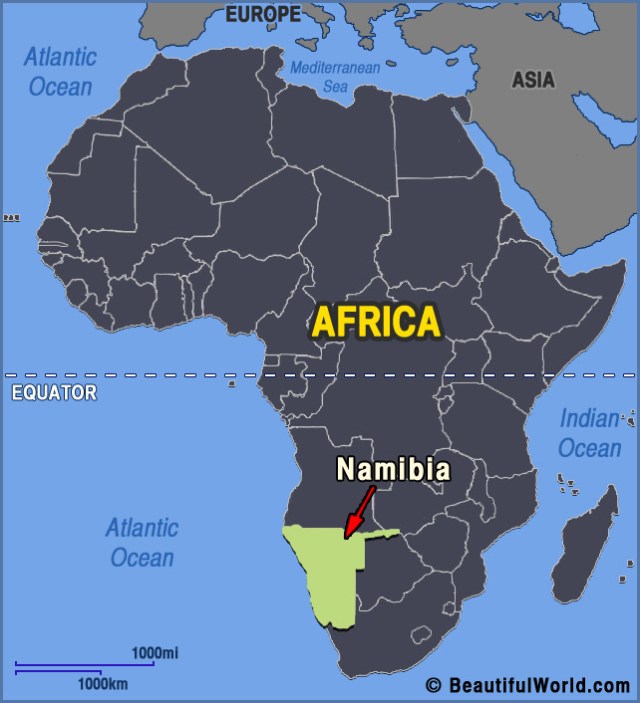
Once we arrived in Namibia we were greeted by our driver who would take us on our way to our first place of lodging.
We arrived at the Elegant Guesthouse and were greeted by a friendly lady called Matilda who informed us of a local bar to eat called Joe’s Beer bar, which you could eat the more unconventional meats of Africa. as a family we decided this would be a splendid idea for a place to go for dinner that night.
Night rolled around quite quickly as currently it is Namibia’s winter. It was really cold so once we arrived at Joe’s bar we were happy to see many heaters and exposed flames. The bar was decorated with many African antiquities, animal skulls and taxidermy.
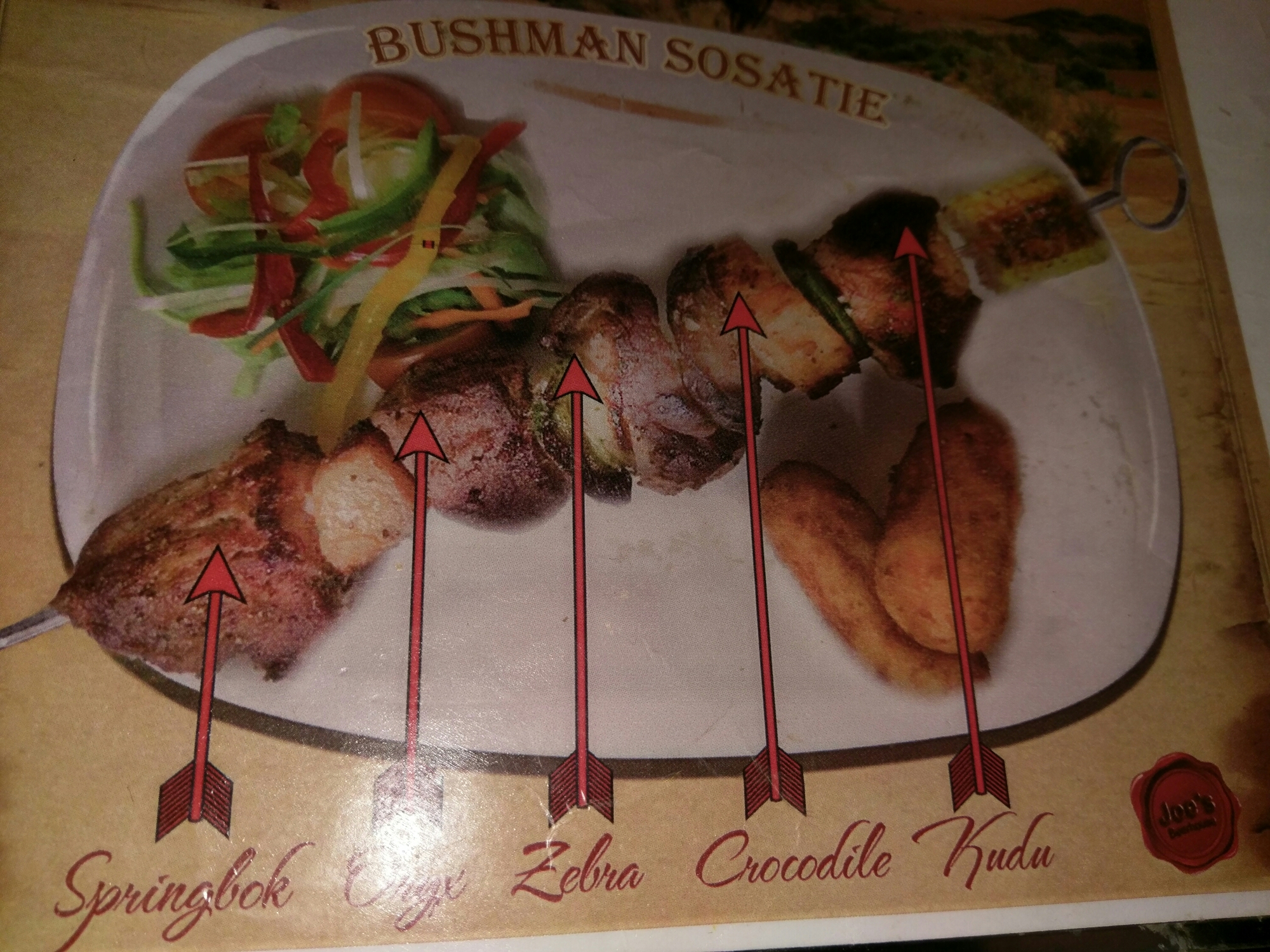
To our delight the menu had pages dedicated to the more bush like meats! I myself ordered the Bushman Sosatie, which consisted of 5 bush meats; Springbok, Oryx, Zebra, Crocodile and Kudu. All of which were delicious.
Shattered after a short drinking session, we travelled back to the Elegant Guest house and settled down for the night.
This summer my family and I will be journeying to Africa on an adventure in Namibia for 14 days. I have avoided reading our itinerary, therefore I am looking forward to the adventure.
Like my blog from Florida, I hope to inform you of what I observe whilst there in a factual but informal way.
Today we headed once more to the Florida Gulf Coast University, our first stop of the day was a short talk on wetlands by Bill Mitsch, who literally wrote The Book on wetlands! From his talk I found that one of the main preconceptions on the most effective way of reducing greenhouse gases is incorrect. This being the fact that rainforests are the best, in fact they have no effect in the reduction, the existing trees in rainforests give out as much gas as they absorb. Newly planted trees would be effective for a duration but not half as much as the key extractors of greenhouse gases: wetlands more precisely mangrove trees. Unlike most plants that give out methane as well as carbon dioxide, mangroves give out methane and Sulphur, and when these two combine they break down to form non greenhouse gases.
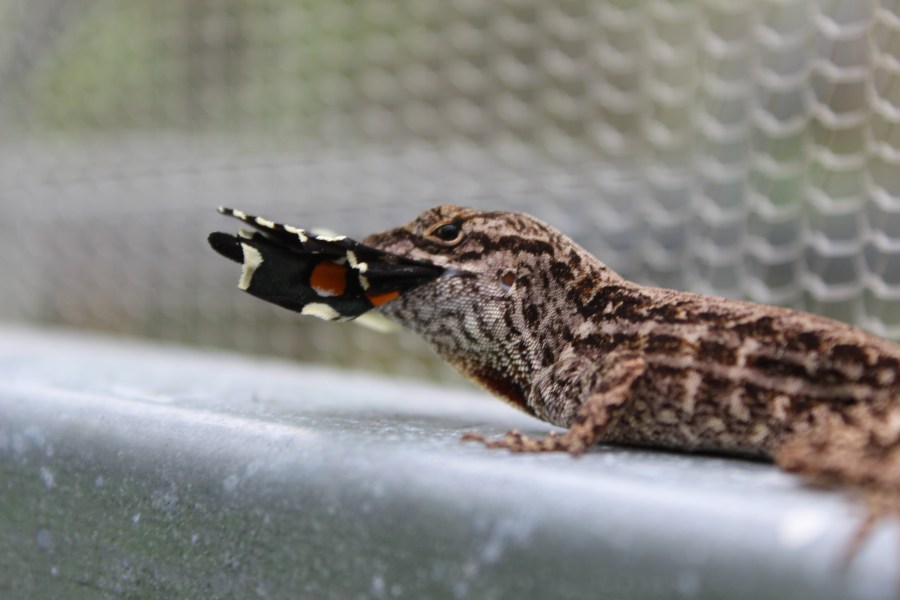
After the talk from Bill Mitsh, we drove to the Naples Botanical Garden where we were told we could explore until a designated time, several people went round recording all the species native and not for their species list. I myself took a more leisurely approach and wondered round just observing what I could see. Finding myself in the butterfly house I found that all the species within were native so I attempted to photograph these for my own list. On leaving the butterfly house I noticed a Cuban Anole on a metal support on closer inspection I saw it was in the process of eating a butterfly I took a photo of this behaviour.
A short walk from the butterfly house is a lake that apparently contained Alligators, after close scrutiny I couldn’t find any. Along the edge of the lake was a large telegraph pole with an Osprey nest on top. Looking around the base, I was lucky to find a small feather, this was a great find as I love birds of prey and this feather would make an excellent addition to my already bulging hat.
On route back toward the centre of the park I bumped into Emma and (thingy), they said they had seen some Green Anoles and showed me a picture I immediately asked the directions and attempted to find them, unfortunately I had no luck only seeing copious amounts of the Brown Cuban ones.
A short while later, we gathered near the entrance where we found out we would be having a BBQ with some university students before the big invasive species talk that night, we would be stopping at Walmart for supplies. On arrival at Walmart I took the opportunity to restock on food and buy myself some steak for a treat being tired of junk food.
We arrived back at the university and gathered in the car park and just as we began to panic that nobody would turn up a pick up truck arrived carrying the BBQ and out of the wood work students began to arrive. It was interesting socialising and hearing with the American students about what they studied and did in their spare time.
Not long after grabbing some food we headed into the lecture room for our talk. The Invasive Species Epidemic, sounded extreme but after listening we began to see the full scale impact, how easy it is for species to transfer and this isn’t just things like animals and plants its microbes, these can get from place to place with ease. The talk proceeded to explain the methods of managing and preventing invasive species taking hold. For example tighter control on borders, fumigating of water and air vessels, such as cleaning the ballast tanks which are a major method that invasive species are often transferred.
As a whole the main method for managing the epidemic would be to ensure worldwide cooperation when it comes to trade and commercial travel between areas ensuring no harmful species are transferred out of their native ranges.
On our last day in Florida, we head over to Lovers Quay where we will hopefully see a Manatee (Time 7:43 am).
We arrived at the public car park, gathering near a small visitor centre and informed by the lecturers that we could go off and wander, meeting back at the area just over a bridge at a set time, before heading to the beach.
On crossing the bridge to the main part of the Quay, we stopped and observed at least three Manatee swimming around minding their own business. Christian was happy that we’d seen them as he could finally prove to Prof’ that they could be sighted in Lovers Quay.
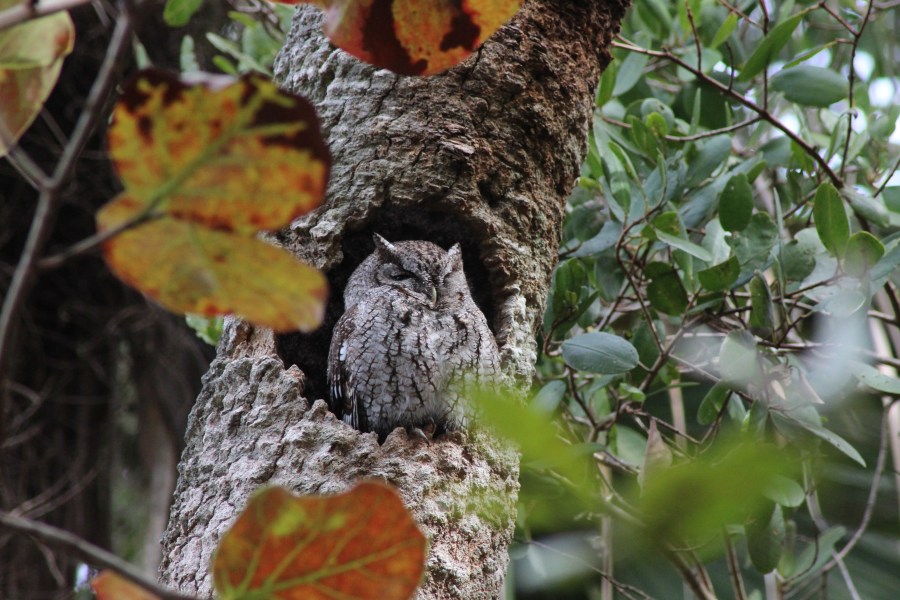
For a short while the group stuck close together, then separating into mini groups. The first exciting find was a sleeping screech owl. Everyone was snapping photos and I don’t blame them as it was really cute looking. Christian was looking at seed pods for a certain form of seed (I think he planned on germinating some back in Bangor). While looking for the seeds he came across an old wasps nest inside a pod.
As the day progressed we began to divide into even smaller groups, Laura and myself went off the beaten track finding some butterflies and creepy looking insects. I even startled a gator that was basking on the edge of the bank, its movement scared me a little as I wasn’t aware of how close I was to it.
I spent a good chunk of the day in search of the elusive Green Anole but had no luck, only finding the common brown Cuban ones. The highlight of the day was getting very close to an Osprey perched on a tree top – it looked very regal and proud.
On the return loop of the walk I caught up with Christian and Tim who were chatting and looking at every rustle in the leaves for the hopeful sign of a Green Anole. Christian was also constantly looking into the water for Manatee. I joined them and after a short while observed both a Pipe fish and a Blue-Gray Gnatcatcher.
We ventured along the trail chatting about various things coming across a swamp area which apparently contained alligators. We all commented on the foul smell and the lack of alligators at this point but then I saw a suspicious looking log. Using my camera I looked closer and realised it was a very well camouflaged alligator, then noticing a further two. We were glad that we’d decided against splashing the water to see if we could make one in the distance move.
We made our way back to the meeting place where I purchased an ice cream and a silly present for Christian – a bottle opener in the shape of a Manatee as he’d not stopped mentioning about Manatees the whole day. (We’d noticed the lecturer’s night time antics as a beer bottle had been left in the van!)’
Once all the students had assembled again we left on the shuttle bus train to the beach. We were informed not to pick up any urchins dead or alive and only shells if we could be sure they had nothing living inside. On arriving at the beach we went off on our own, most people just sunbathed whereas Sam and I decided to make the most of it and go for a wander as wanted to get the last few birds for his 100 bird total list and myself and I wanted to explore and find “cool” things. After a good long walk up the beach, we came across all sorts of shells, a brittle star which American Oyster Catchers were feeding on.
The find of the day was definitely found on our return to the pick-up point. We walked along the water’s edge and Sam thought he saw a horse shoe crab but proved to be a leaf. We talked about the chances of actually finding one and to add insult to injury what did I see but a Carapace half buried in the sand. It turned out not only to be the front but the tail also. I picked it up and shook it out it to find it was almost complete. I was definitely not going to leave this behind so I smuggled it from the beach in my towel.
After a short shuttle ride we arrived back at our buses and returned to Vesta and had a debrief of the day’s events and learning the reason Lovers Quay was called Lovers Quay – this is because once upon a time it was an island were ‘lovers’ went.
We then held a small quiz about the day’s events followed by the photo and species index competition, the results of which that everyone entering their species list won, as we had all done them in different ways making it impossible to choose.
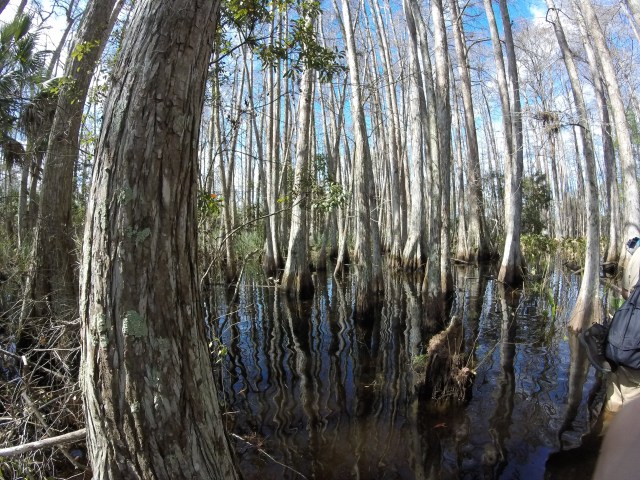
Today we went to Corkscrew swamp. This is a 500 year old forest of giant Bald Cypress trees, these were saved from destruction in 1954 by Audubon. It rises up to 30 metres from a swampy area of Strangler Figs and native grasses. This habitat is shared with the Pond Apple and Red Maple trees along with the seasonal Ghost Orchid. There are lakes within the forests and these are ideal places for many types of waders and other water feeding birds. Vast amounts of migratory birds visit this area including the beautiful coloured Painted Bunting.
Corkscrew is a now a 13,000 acre permanent and seasonal paradise for endangered and under threat species whose survival indicates the overall health of the Everglades. The swamp has a long section of boardwalk to enable visitor access whilst keeping the area untouched. It was like walking into something from Jurassic Park; going from the grasses to a dense swamp forest you could see birds flitting around and you could imagine something prehistoric lurking in the shadows. On one of the side paths a Raccoon was sighted; several of us were using the Canadian nick name for them ‘Trash Panda’. Unfortunately, the amount of people gathering around scared it to a distance and by the time I got there to take my identification photo it was no more than a piece of fluff in the grass!
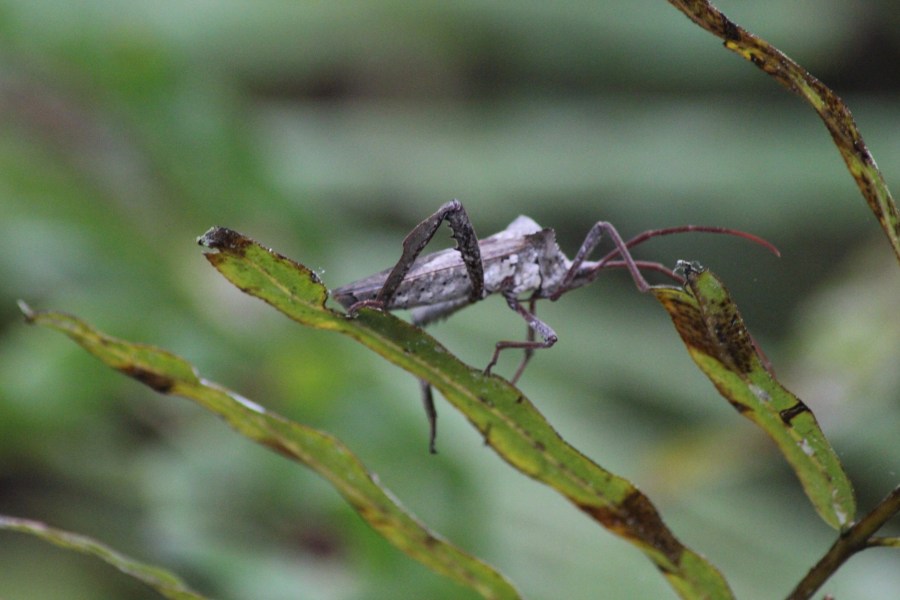
The boardwalk took some time, a good deal of this I spent yet again looking for the allusive Green Anole (no luck again). There was an unexpected downfall of rain whilst in the Cypress swamp making people scatter for shelter. Not caring about the rain, in fact I actually enjoyed it. I stayed out to see the effect it made, this in fact made the majority of birds disappear. After the downpour the birds slowly re-emerged. Towards the end of the boardwalk Laura spotted something – a large insect something like the Shield bugs we have in the UK, it was huge I took several photos which I later identified as a Florida Leaf Footed Bug.
On arriving back to the visitor centre I had a small sleep in a lovely rocking chair as I was still exhausted from the 24 hour plague. After waking up I went over to the bird feeders to find Sam taking photographs. It must have been my good luck because not long after we got not one but several rare bird sightings: the Rose Breasted Grosbeak, Indigo Bunting and the Painted Bunting which Sam had been determined to see the whole trip.
After spending the morning in Corkscrew it was suggested to go to the Bonita Beach which is local to the Vesta Field Station. We were all up for this and made a mad dash to the souvenir shop for beach supplies! I purchased myself a skimming ball that actually skims (sounds too good to be true). We ditched all of our gear at the Field Station before heading out again.
Bonita Beach is accessed via a private walled estate area, with upmarket houses and boats on either side. This is the sort of thing you would expect a drug baron on CSI Miami to live! It seems absurd to think these are probably holiday homes, some of them were bigger than the average house.
On arrival to Bonita beach we were treated to the site of a Gopher Tortoise crossing the road, it reminded me of an old man. We decided to get out the van to have a look and saw another tortoise not too far away in a burrow. We took several photos including one of the crossing sign that had a cartoon tortoise on.
We proceeded to look around the visitor centre picking up free shells and shell guides. We went along to the beach along a board walk and found an area to pitch our towels. Within seconds people were in the sea, the lecturers had purchased some beach balls to have some fun, so instead of topping up my tan I decided to join in with them. We had a good laugh and by the end we had two American footballs my skimming ball and a Frisbee on the go at once it was chaotic, but FUN! We returned back to the Vesta Field Station to eat and sleep.
Today we learned about the key invasive species of Florida and the Everglades.
We also went Snorkelling scroll to bottom for more on that.
We had a talk from someone who works with the management of the education and removal of the invasive species.
He outlined the key aspects to dealing with invasive species these are prevention early detection and rapid response.
He stated that there are currently over 600 invasive species found in Florida over 50 of which are reptiles, the reason for Florida having so many invasive species is the climate, these ideal conditions are often and improvement from those of the species native range.
The longer the species is present in an area the larger its area of invasion is likely to get, the worst of the invasive species is the plants.
Some of the more destructive invasive species found in Florida are:
The Nile Monitor: these ruin nests of any ground nesting animals these have been listed as a conditioned species so cannot be owned as pets.
The current population has been breeding since 2012 and the most effective way to remove them is killed them with guns from boats.
The Burmese Python: this species was discovered in Florida around the 1970’s and a breeding population was confirmed in the early 2000’s these are also listed as a conditional species and can reach up to 18ft long the longest being 18.8ft, they have increasingly been found in south west Florida.
Rock Python: 30 of these python have been caught and there is a good chance they are in decline.
Other snake species are as follows: Green and Yellow Anaconda and the Boa Constrictor.
A highly destructive but annoyingly cute looking lizard is the Argentine Black and white Tegusthese are from South America. Their diet varies and they have the ability to over winter in burrows. The tegu is a listed species and is endanger in its native range so cannot be harmed only removed. There is little known about the agricultural impact the tegu could have.
The Black Spiny Tail Iguanais questionable to if it’s invasive or not, they are omnivorous and share the burrows of Burrowing Owls, this may be problematic when the owls have eggs, they have been known to eat Gopher Tortoise eggs.
There are 3 known invasive species of Chameleon these are the Oustalet, Veiled and Panther.
Non-native deer present in Florida are the Barasingha, Axis and the Red Stag of which the Barasingha is an endangered species so cannot be killed.
There are several initiatives in place to manage the invasive species such as canal surveys and fish tournaments to attempt to reduce numbers.
The python challenge is another way to educate people into what pythons look like and how to catch and kill them. The duration of the challenge is roughly a month and gives a large amount of data to the location of the invasive pythons.
Enough facts time for something awesome SNORKELLING!
Water Temp: 22°c
After a long day of being educated it was decided we would go snorkelling at from the Florida Keys this was a long drive especially after being ill but I was not going to miss it. We arrived at the booking place well in advance and had to kill some time so Sam Whittaker and I went exploring through the bushes finding Anoles everywhere we even came across several locust/grasshopper type bugs one we believe is a Katydid.
After a while the last bus turned up and we set off to the keys where we eventually (girls take ages to change) boarded the boat to head out to the sea, I went up on top deck it was beautiful, on arrival to the reef we were given a safety talk and additionally to that a set of rules which were in place to preserve the reef this was very good to hear them taking so much good care of the reef. So after diving in GoPro in hand it didn’t take me too long to find some fish and I was diving and filming continuously, I even saw a Barracuda, although by far the best sighting of the day must have been the Nurse Shark.
Today we drove down Alligator Alley and there was a inter van competition to see who could count the most. Our total was around 60 alligators.
Halfway through the journey into Panther territory, illness overcame me. I have no idea what caused it. I have a hunch it was a breakfast burrito (shame as it tasted great), but could have been a bug. I then proceeded to throw up every half an hour and feel totally fine in-between this was very annoying. On the upside I didn’t miss any panthers. Not a single one was seen on the road supposedly where the most sightings occur.
While suffering I managed to still go on the treat of the day a trip round the Everglades on an airboat. Not the wisest thing to do but I was determined to do this once in a lifetime opportunity and oh it was worth it! We set off slow and I was panicking about throwing up but as soon as we left the channel the driver put his metaphorical foot down and launched the boat forward at high speed. We went from a narrow river channel to a large wetland grass environment in minutes where we saw various birds. We proceeded to do several drift like turns, like those you would expect in a movie.
We moved to one of the manmade canals that is deeper than the main areas of the Everglades. This was an area where the guide knew where the alligators would be that he had given names. I think one was called something like Derek but I can’t be sure. After a fair amount of whistling he got Derek to show his face the guide proceeded to give a brief talk about him, I was more focused on not throwing up in gator infested water! Leaving Derek and his gator gang behind we returned back to the dock, where the rest of the students went for a brief talk from one of the guide people (very touristy), they also got to hold a baby gator. Unfortunately, when everyone else was having a great time holding a baby alligator (very jealous) I was incredibly sick the boat trip had taken the last of my energy I can’t remember too much after that besides sleeping on the long journey back broken up by a brief vomit.
On arrival back at the Vesta Field Station, Christian suggested as we were early that we go canoeing, having just purged my stomach for the last time I felt it would be worth the risk and it was! We saw various mangrove dwelling organisms including a Pileated Woodpecker.
The second video is of us observing a mangrove crab.
I didn’t even make the nights debrief I was so exhausted.
(Hope you enjoyed the details of the 24 hour plague, I was not the first or the last to suffer.)
Today, we set off towards the Florida Gulf Coast University, to learn about the process of ringing birds (banding in the USA) and go slogging in the Cypress forest.
On arrival, we were treated to the sight of a woodpecker clinging to a dead tree. We took photographs of it pecking for food, while waiting for the bird ringing activity to start.
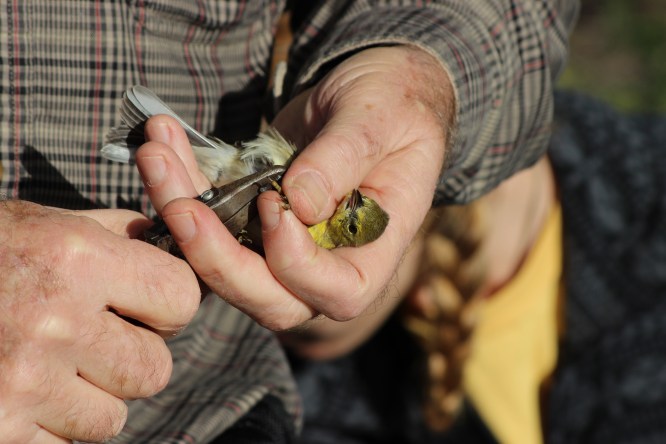
A short while later, we were met by the guy in charge of the bird ringing; he led us to a wooded area not far from the University car park. Within this wooded area, a mist net had been set up. This netting is completely humane and designed to catch the birds with the least amount of stress and harm possible. The nets had already caught a few birds, these were Pine Warblers a lovely green and yellow colour.
To keep the birds from being hurt, they were placed into socks which being dark kept them calm. They were then carried out to a table that had been set up in the car park with all the bird ringing resources. Once, we were all gathered around the table the bird ringer proceeded to tell us the history of bird ringing.
He then proceeded to note down the age, the weight and the gender of the bird in a note-book next to the rings serial number. If a single ring is lost it needs to be deleted from the list. The bird was then released and we returned to the woods to look for larger birds. Several Gray Catbirds had been caught and were now ready to be ringed. At that same moment, a member of staff said that a Painted Bunting had been sighted, so Sam Whittaker and I asked if we could search the woodland for it on our own whilst the Gray Catbirds were being ringed. We were granted permission and set off in search for the Bunting. Unfortunately, we were unable to find it although we were treated to the playful behaviour of a Northern Cardinal.
After the demonstration of ringing we gathered by a small pond to wait for a man called Wynn. He was a true individual, cool and totally happy with life. He took us to the two wetland habitats we were allowed to explore. The first was only ankle deep and consisted of grasses, the other was much deeper. These wetland areas are as a result of a construction company digging drainage trenches, these areas are unique as construction company’s usually only dig long shallow drainage trenches.
We didn’t spend long in the shallow area as there wasn’t a lot of wildlife to see. On the way to the deeper site Sam found a partial snake skin which was apparently from a Racer.
On arriving at the deeper area, we observed a huge contrast between the two wetland areas. This wetland had huge Cypress trees and an area consisting of grasses dividing them from Pine trees closer to the road, this area is called a firebreak. The pines that are resistant to fire grow on the one side and the Cypress trees grow on the water rich side.
Firebreak Cypress swamp area at the rear of photo.
I ventured into the Cypress forest with Sam and Laura. We headed for the deepest part as it was known to be a better place to find the more interesting organisms. Indeed it was, within minutes we found various species of water spiders and other insects. It is a shame that they are so hard to photograph without a macro lens and I ended up trying with my GoPro but to no avail.
Sam wandered off, almost falling over after stepping into a small sinkhole submerged under the water but luckily steadied himself before he drenched his camera. Laura and I were busy looking at each insect we found, Sam on the other hand was determined to find frogs and snakes. Little did he know we had already come across two frogs along with many Cuban Anole lizards after he had slogged off.
Wetland (Deep)
A short time later, someone exclaimed “SNAKE!” A few of us slogged our way through the water with Laura half drenching herself on the way. Indeed there was a snake, it was an Eastern Ribbon Snake, working its way towards where I was standing, slithering over the fallen trees and wetland vegetation. Sam had arrived at this point and we decided to catch it. I attempted first and it hissed at me so I backed off. When it was most exposed, Sam leant forward and caught it, unfortunately for him it began to musk making him stink. We proceeded to pass it around the group that had gathered. It behaved extremely well for a wild snake and after a short while we placed it back on the fallen tree and left it be.
On leaving the Cypress forest we travelled down the same road on the opposite side and Wynn proceeded to open up the manholes in search of more snakes. Instead, he found hatched eggs which he assumed to be from Racers. For a little fun, he suggested we washed ourselves off in the University fountain before eating lunch in the cafeteria.
After eating ourselves silly we headed to another part of campus to listen to a talk on the Florida Panther.
The Florida panther ( puma concolor coryi ) firstly is not black its a common misconception that all big cats with black pigment are panthers whereas the only panther, is the Variant of cougar from Florida. There are approximately 120-180 panthers left in the wild . They are critically endangered , a panther males territory is 200 square miles overlapping with females the female only has only about 80 square miles. The Florida Panther breeds all year round although gestation take 3 months. the common threats to Panthers are:








 Zoological Adventures featuring Tom Everley